Laser Cut File Layered Turtle Sea 3D: A Practical Guide to Plywood Crafts
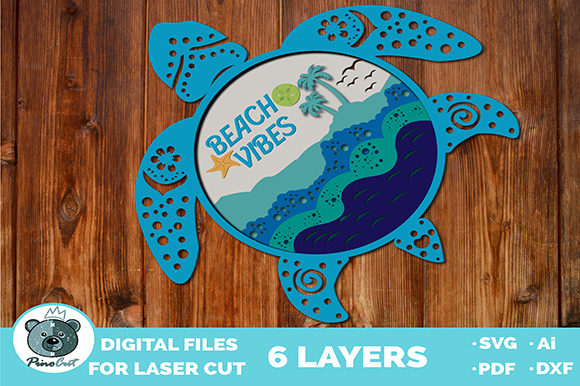
There is something undeniably satisfying about watching a flat sheet of material transform into a dimensional object through the precise heat of a laser. For hobbyists, educators, and small business owners alike, the Laser Cut File Layered Turtle Sea 3D represents more than just a cute sea creature; it is a streamlined entry point into the world of vector-based manufacturing. This project is designed for CNC machines and laser cutters, offering a digital blueprint that turns raw plywood into a striking three-dimensional wall art piece or decorative shelf accent.
The beauty of this specific file lies in its simplicity and adaptability. You are not dealing with complex assembly jigs or obscure hardware. Instead, you receive an archived package containing vector drawings optimized for electronic cutting plans. The design relies on layering—stacking individual cut pieces to create depth and shadow, which gives the turtle its characteristic "sea 3D" appearance. It is a project that respects your time, allowing you to download, modify, and produce without a steep learning curve.
Why Plywood is the Ideal Medium
When discussing laser-cut projects, material selection often dictates the final aesthetic and structural integrity. While acrylics and metals have their place, wood brings warmth and organic texture that resonates deeply with home decor enthusiasts. For the Laser Cut File Layered Turtle Sea 3D, we strongly recommend using 3mm plywood. This thickness strikes a perfect balance between durability and ease of handling.
Thinner materials might warp over time or lack the rigidity needed for standing displays, while thicker boards can be difficult for smaller desktop laser cutters to slice through cleanly, potentially leading to charred edges that require extensive sanding. At 3mm, the plywood holds its shape well when stacked, yet remains light enough to hang easily on a wall or place on a desk. Furthermore, plywood is cost-effective, making this project highly economical whether you are crafting a single gift or planning for mass production.
Real-World Applications and Use Cases
The versatility of this layered turtle design allows it to fit seamlessly into various contexts. Here is how different groups are utilizing these files in practice:
- Educational Tools: Teachers and parents use this project to introduce children to marine biology and engineering concepts. Assembling the layers helps develop fine motor skills and spatial reasoning. The turtle becomes a tactile lesson on ocean conservation, sparking conversations about sea life preservation.
- Home Decor & Interior Design: In modern coastal-themed interiors, minimalist wooden art is trending. This 3D turtle serves as a sophisticated focal point in nurseries, bathrooms, or beach houses. Because it is made of natural wood, it complements both rustic and contemporary styles without feeling out of place.
- Corporate Gifting & Branding: Small businesses looking for unique promotional items find value in customizing these designs. By modifying the vector layout, companies can integrate their logos onto the turtle’s shell or background elements. It offers a memorable, eco-friendly alternative to plastic trinkets.
- Event Decorations: For baby showers, bridal showers, or nautical-themed parties, these layered turtles make excellent photo booth props or table centerpieces. They are lightweight, easy to transport, and add a personalized touch to event styling.
Customization: Making It Yours
One of the strongest advantages of receiving the Laser Cut File Layered Turtle Sea 3D in an electronic vector format is the ability to tailor the design. You are not locked into a static image. Once you download and extract the archive, you have full control over the scale, orientation, and details.
If you are running a high-volume operation, you might adjust the spacing between layers to speed up assembly or change the overall dimensions to fit specific packaging constraints. For individual crafters, personalization is key. You can resize the turtle to fit perfectly on a child’s bedroom door or expand it to become a large statement piece for a living room mantel. The vector nature of the file ensures that scaling does not result in pixelation or loss of precision.
The Assembly Process: Simplicity Meets Satisfaction
After the cutting phase, the real magic begins. The project is engineered for ease of assembly. Typically, these layered files utilize a slot-and-tab system, where each piece interlocks with the one below it. There is no need for glue if you want a clean, mechanical look, though adhesive can be used for extra stability if desired.
This modular approach makes it incredibly easy to troubleshoot. If a piece doesn’t fit quite right, you can simply adjust the fitment before committing to the final stack. Once assembled, the product invites further creativity. The natural grain of the 3mm plywood provides a beautiful canvas. You can leave it unfinished to highlight the wood’s natural beauty, stain it for a richer tone, or paint it in vibrant colors to match a specific theme. Adding decorative elements like beads, sequins, or resin accents on the shell can elevate the piece from a simple craft to a gallery-worthy sculpture.
Considerations for Success
While the Laser Cut File Layered Turtle Sea 3D is designed for user-friendliness, there are practical considerations to keep in mind to ensure the best results.
Machine Calibration: Ensure your CNC or laser cutter is properly calibrated for 3mm plywood. Incorrect focus height or power settings can lead to incomplete cuts or excessive burning, which may affect the tightness of the interlocking layers. Always run a test cut on scrap material first.
Material Quality: Not all plywood is created equal. Low-quality sheets may contain voids or inconsistent densities, which can cause the laser to cut unevenly. Investing in a higher-grade birch or poplar plywood will yield smoother edges and a more professional finish. Smooth surfaces also make painting and decorating significantly easier.
Design Modification Limits: While you can modify the layout, be cautious about altering the core structural geometry. Changing the width of the connecting tabs too much may compromise the structural integrity of the 3D stack. Keep modifications within reasonable bounds to maintain the intended aesthetic and functionality.
Scalability for Makers
For those thinking beyond a single hobby project, this file structure supports scalability. Because the design is vector-based, it lends itself well to batch production. You can set up a production line where one person handles the cutting, another manages the deburring (removing soot or loose fibers), and a third oversees the assembly and finishing. The uniformity of the laser-cut parts ensures that every turtle looks consistent, which is crucial for retail sales or bulk orders.
The economic aspect cannot be overstated. With the low cost of materials and the minimal labor required for assembly, the profit margin on finished products can be healthy. Whether you are selling at local farmers' markets, online craft platforms like Etsy, or supplying boutique stores, the Laser Cut File Layered Turtle Sea 3D offers a reliable product that appeals to a wide audience. It bridges the gap between digital design and tangible craftsmanship, providing a rewarding experience for anyone willing to press "start" on their machine.
In summary, this project is more than just a file; it is a toolkit for creativity. It empowers makers to produce high-quality, customizable decor with minimal overhead. By leveraging the precision of laser cutting and the warmth of plywood, you can create pieces that resonate with buyers and bring joy to spaces. The process is straightforward, the outcome is visually striking, and the potential for growth is limitless.